23_The Magic of English
Over the next few weeks my introductory sociolinguistics students are doing a group work task in which they explore the linguistic landscape in their suburb and relate the visibility of languages in public space to the linguistic profile of their suburb as it appears in the census data published by the Australian Bureau of Statistics. I can’t wait to see the outcome of their research and, in the meantime, will run a little mini-series on the burgeoning study of linguistic landscapes to accompany their work.
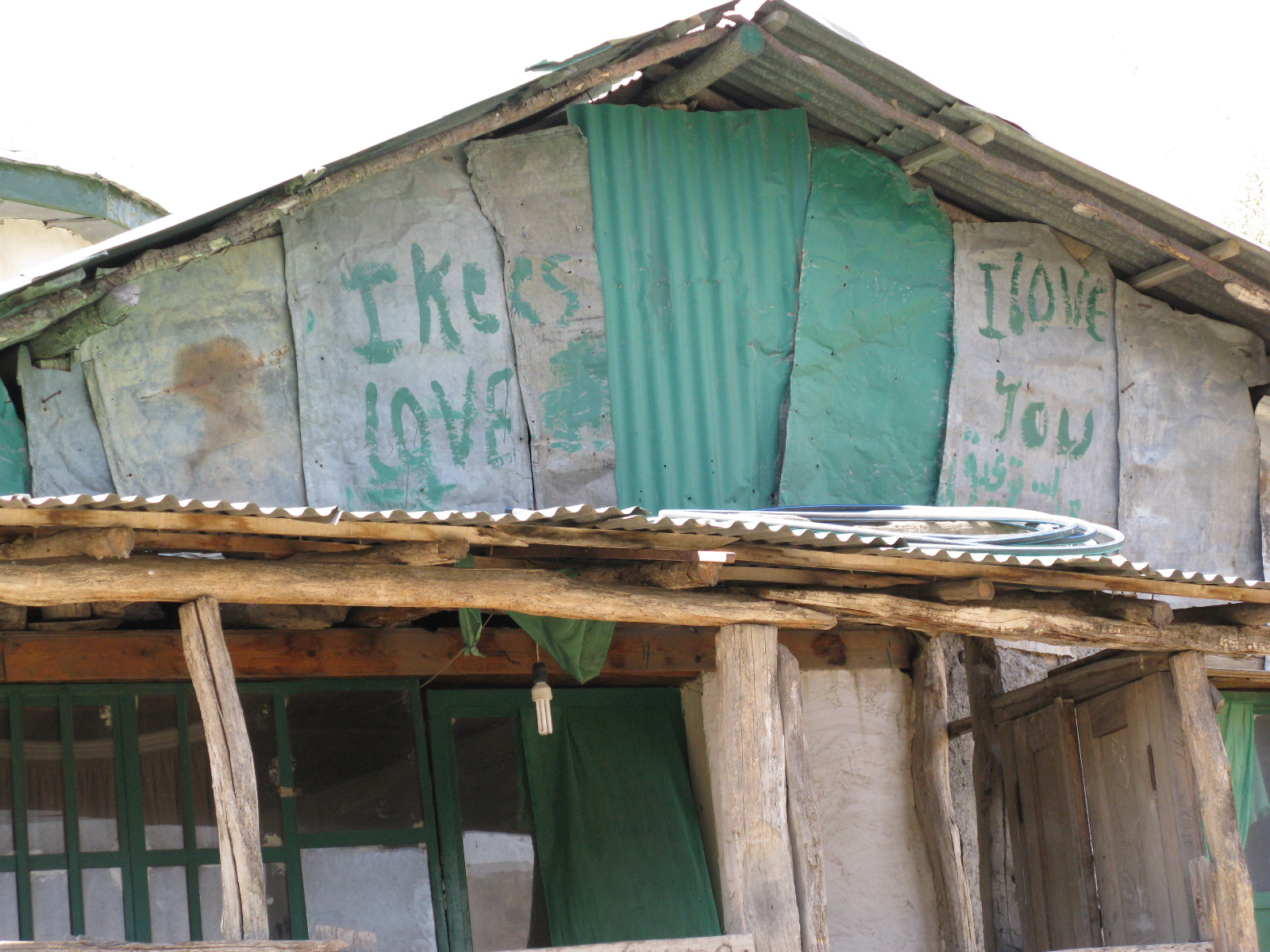 I’m starting this mini-series with this graffiti, which I found truly startling when I firstencountered it as it invests English with magic, religious feeling, and love. The graffiti “I kees love” (which I think should be “I kiss love”) and “I love you” appears on an imamzadeh, a shrine, in the Alborz Mountains in Northern Iran. The only way to reach this shrine is on foot or on horseback. The closest hamlet – all but deserted and inhabited only in summer time – is a three hours’ walk away. Traditionally, the shrine has been the goal of pilgrims who have family matters that they want to pray over. I walked that path last year. It’s an amazing hike through stunning scenery and solitary mountain wilderness. Imagine my surprise when after a long hike – one of those that are exhausting as they are exhilarating – we arrived at the shrine to be greeted by English graffiti! Here I was in a remote corner of one of the most isolated countries on earth (if you look at Iran through Western eyes, that is): to read “I kees love” and “I love you.” The sentiment expressed seemed quite appropriate to the magic and mysticism of the place. That the sentiment is expressed in English instead of Persian came as a surprise: for the writer, English must have been the language of love and now the magic of English is inscribed in that holy place!
It also turns out that Iran is far less distant than we like to think
p.s.1:this article is adopted from language on the move.the author of this article is Ms.Ingrid Piller.I  i DO really ask for her forgiveness .because i had forgotten to mention her name.
i acknowledge my gratitude to Mr.keimasi who gave me permission to publish the post of his blog.
p.s.2:this article carries some other connotations in addition to it's linguistic aspect.I'm kindly awaiting your own understanding.
.p.s.3:(Based on a comment):**The sentence under the English ‘I love you’ is, in fact, in Arabic.)It is semantically equivalent to the English "Blessing comes only from God

 )
) )رفتم انقلاب وکتابی خریدم به اسم"قرون وسطی اولیه"و دو کتاب از شهید مطهری.
 ای که مرا خوانده ای